An AI licence gives you a brain, not hands. See how MCP servers connect your enterprise data and tools to agentic AI - securely built and governed.
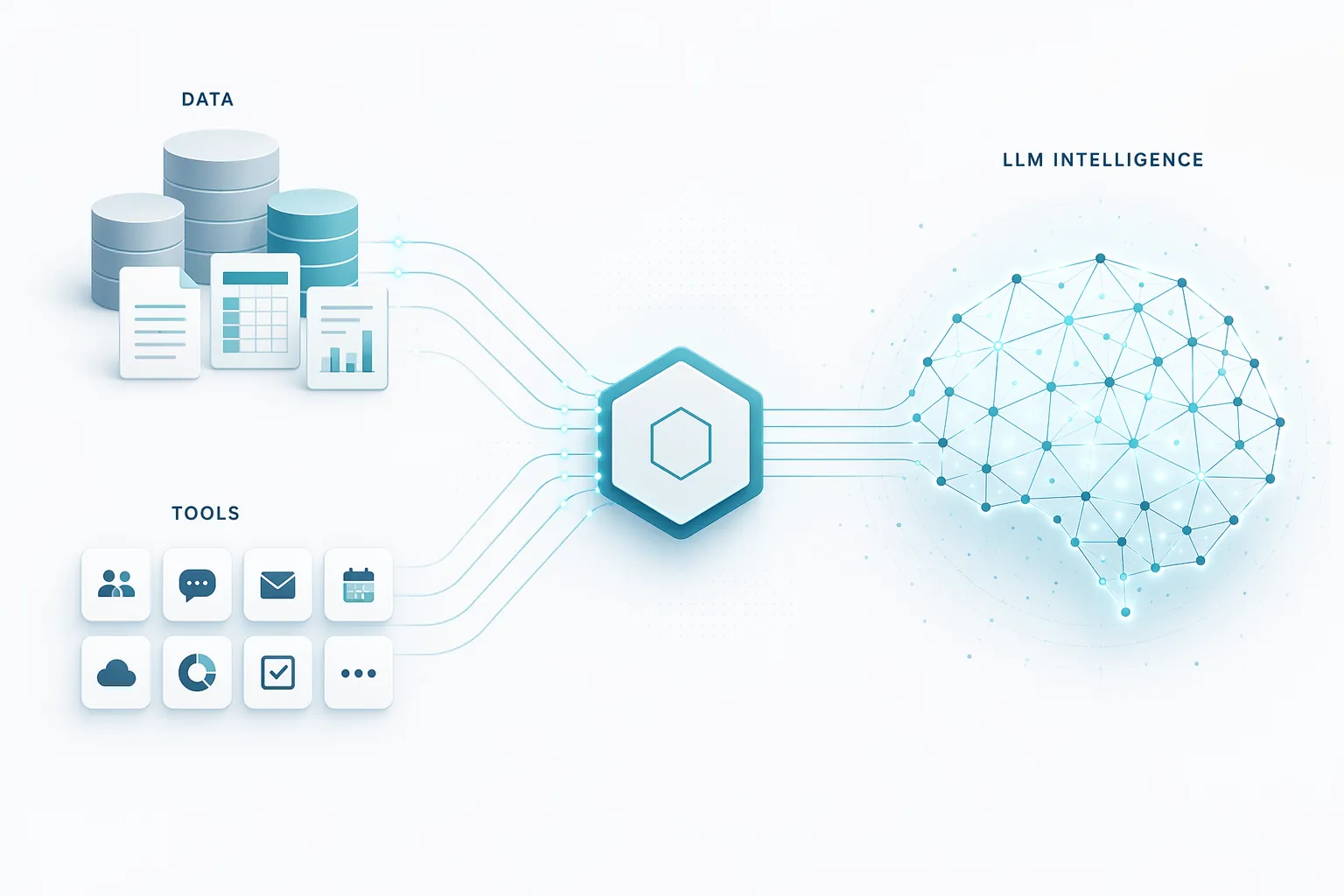
You can buy the smartest model on the market and it still cannot read your invoices, update a customer record, or pull a number from your enterprise resource planning system. Between a capable model and a useful agent sits an integration problem - and until recently, every company solved it from scratch. The Model Context Protocol is the standard that changes the situation.
A subscription to a frontier model buys you a brain, not hands. The model can plan, summarise, and decide; what it cannot do on its own is reach into your systems and act. Everything that turns an assistant into an agent lives in the connection between the model and your data, and that connection has to be built.
Historically it was built badly. Every AI app that wanted to touch a data source needed its own bespoke connector, and every new source multiplied the work. Connect M applications to N systems the old way and you face M×N custom integrations to build and maintain - the so-called M×N problem.
Each connector is code someone has to write, secure, and keep working as the underlying system changes. It is why so many AI pilots stall at the demo. The model impresses in a sandbox, then meets the reality of many internal systems and no standard way in.
The Model Context Protocol collapses that maths. Build a connector once, and any compliant AI app can use it - build-once, connect-everywhere instead of wire-everything-to-everything.
MCP - the Model Context Protocol - is an open standard for connecting AI applications to external data, tools, and workflows. Anthropic created it and released it openly on 25 November 2024. Anthropic's own shorthand is that MCP is "a USB-C port for AI": one standardised socket, so any model can plug into any system without a custom cable for each pair.
It matters that MCP belongs to no single vendor. OpenAI adopted MCP across its products, including the ChatGPT desktop app, in March 2025; Google DeepMind followed in April 2025. The three organisations that build the leading models now speak the same integration language, which makes MCP a safe standard to build on today whoever leads tomorrow.
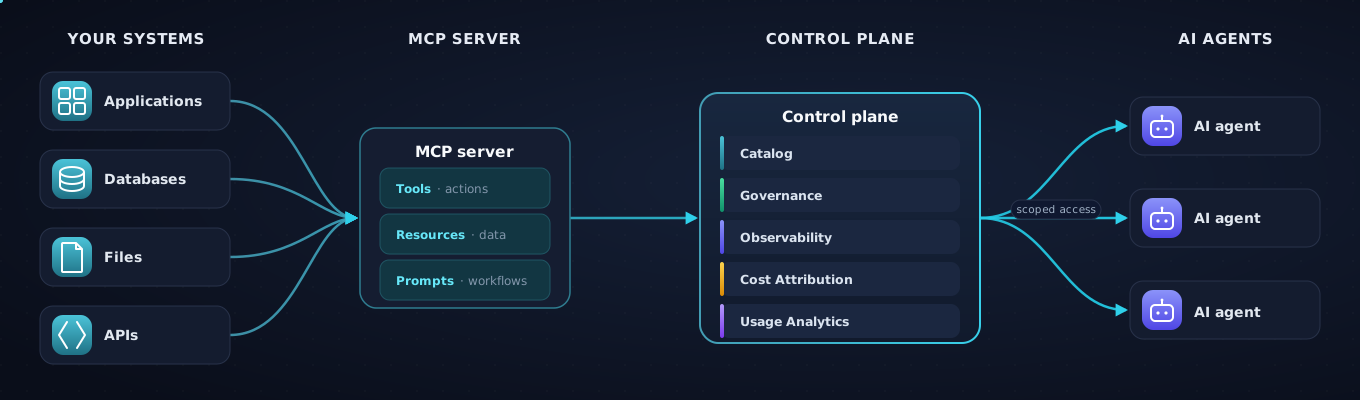
The control plane shown in-path is Kern Mind's optional governed layer, not part of the base MCP protocol; it is covered in "Where Kern Mind comes in" below.
Three roles make up an MCP connection. The host is the AI application, the agent itself. Inside it runs one or more clients, one per connection. Each client talks to an MCP server, which sits in front of a real system and exposes it in a form the agent can use. Host and server exchange messages over JSON-RPC 2.0, a lightweight, well-understood remote-procedure-call format, so the wire protocol is boring and predictable by design.
A server exposes three kinds of capability. Tools are actions the agent can take: create an invoice, send an email, query an order. Resources are data the agent can read: a document, a database row, a file. Prompts are reusable workflows the server offers to guide a task. That vocabulary is deliberately small, which is what lets one agent work across dozens of servers without custom glue for each.
Security is the substance here. The emerging practice is OAuth 2.1 with granular, scoped access: a token that lets a specific agent read invoices does not also let it delete customers. Scopes are also how you get multi-tenant isolation, so team A's agent can never reach team B's data, and the server itself enforces that boundary.
Authorisation is only half of it. Real servers time out, rate-limit, and fail, and an agent that treats a dropped call as success will quietly corrupt your data, so retries, timeouts, and idempotent tool design are not optional. You also need observability: every tool call logged and traceable, so you can answer "which agent did what, to which system, when" without reconstructing it from memory after something breaks.
The protocol standardises the plumbing. It does not decide who is allowed to call what, how you'll audit it, or what it costs, and at scale those are the questions that actually keep a system safe.
Our work is two layers. First, we design, implement, and operate the MCP servers themselves - building custom servers for your in-house systems, and wiring up official or SaaS servers where they already exist. This is the layer that turns your ERP, CRM, databases, and spreadsheets into things an agent can actually use, with the auth and isolation described above built in rather than bolted on.
Second, we can design and build a control plane - a governed gateway the servers sit behind, so every agent reaches your systems through one policed path rather than a direct line. It is the operational layer that answers the CTO's real question: how do we run this safely across teams and agents without losing track of it? We build it scaled to what a client needs, with more or fewer capabilities as the estate grows.
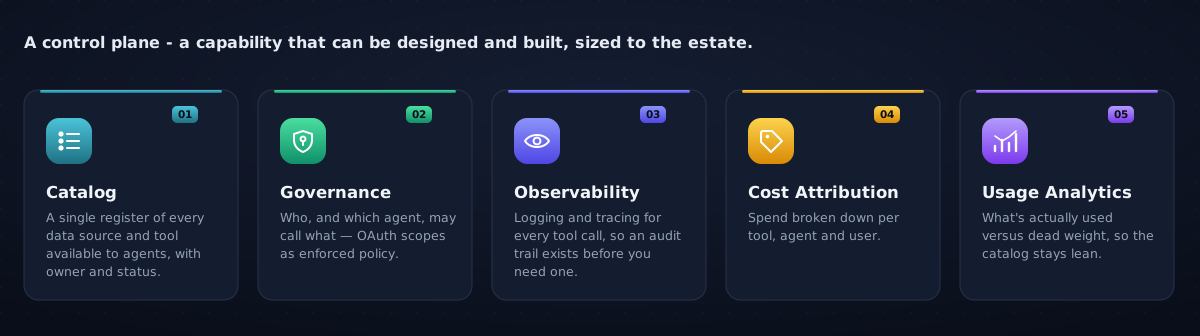
The grid above names the five capabilities; what matters is why a CTO needs them together. Catalog and Governance answer "who may call what" and turn OAuth scopes into enforced policy. Observability and Cost attribution make every call auditable and give AI spend an owner and a budget. Usage analytics keeps the catalog lean instead of accreting connectors nobody uses.
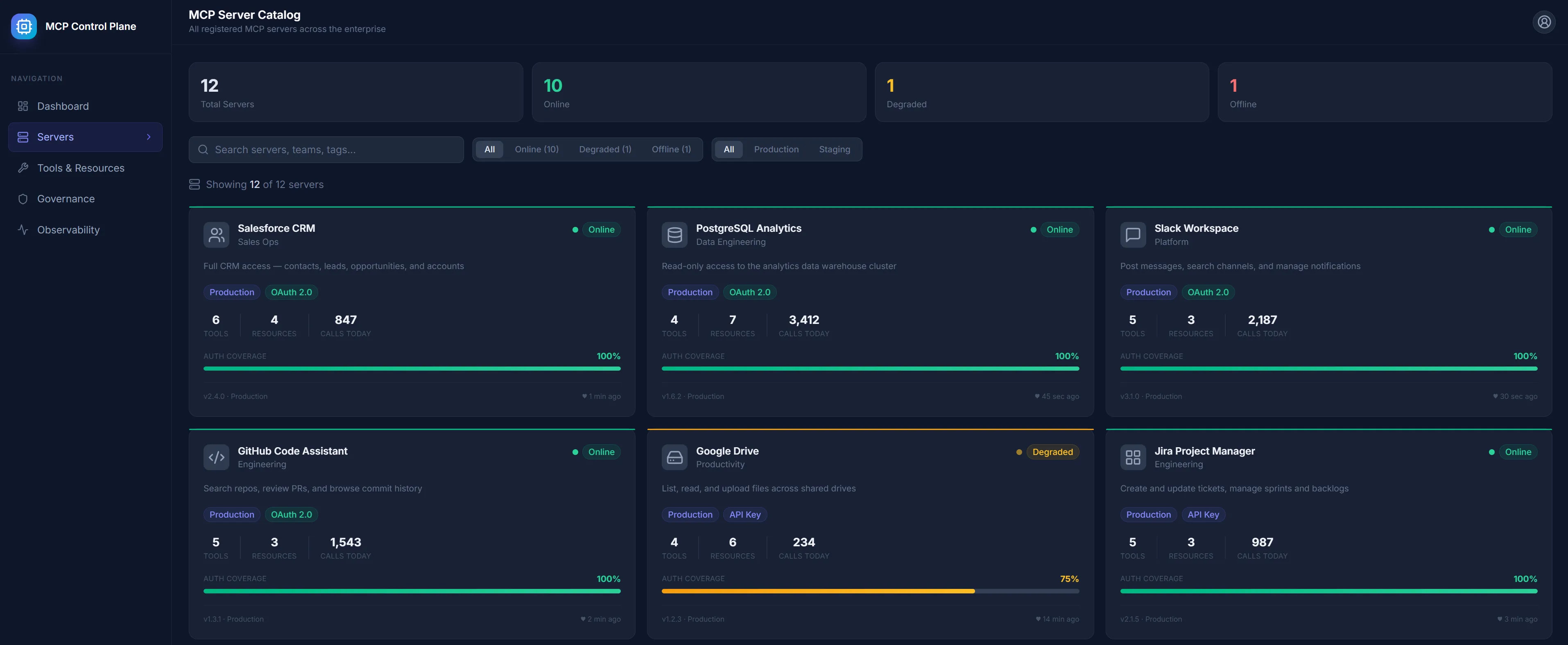
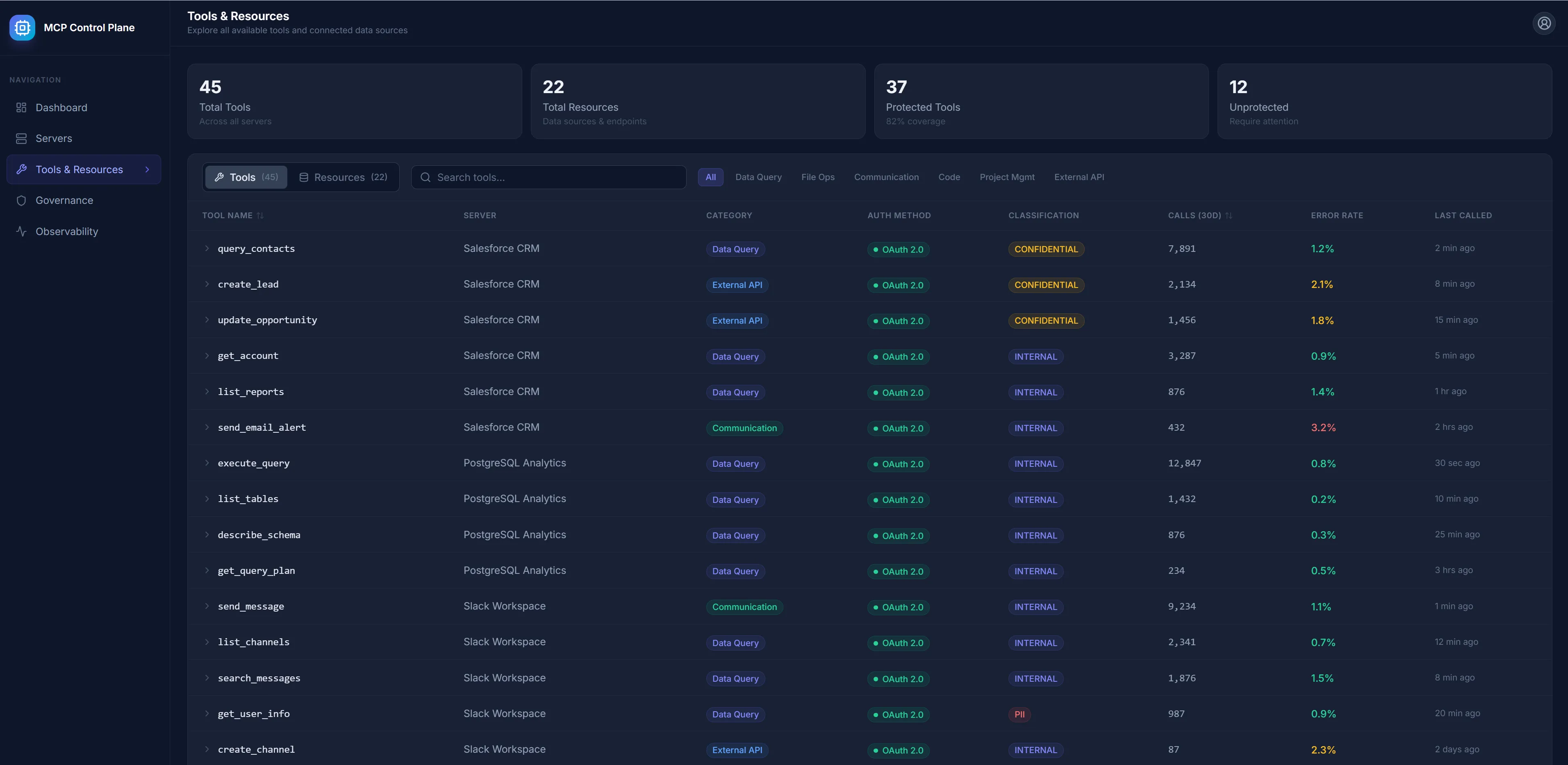
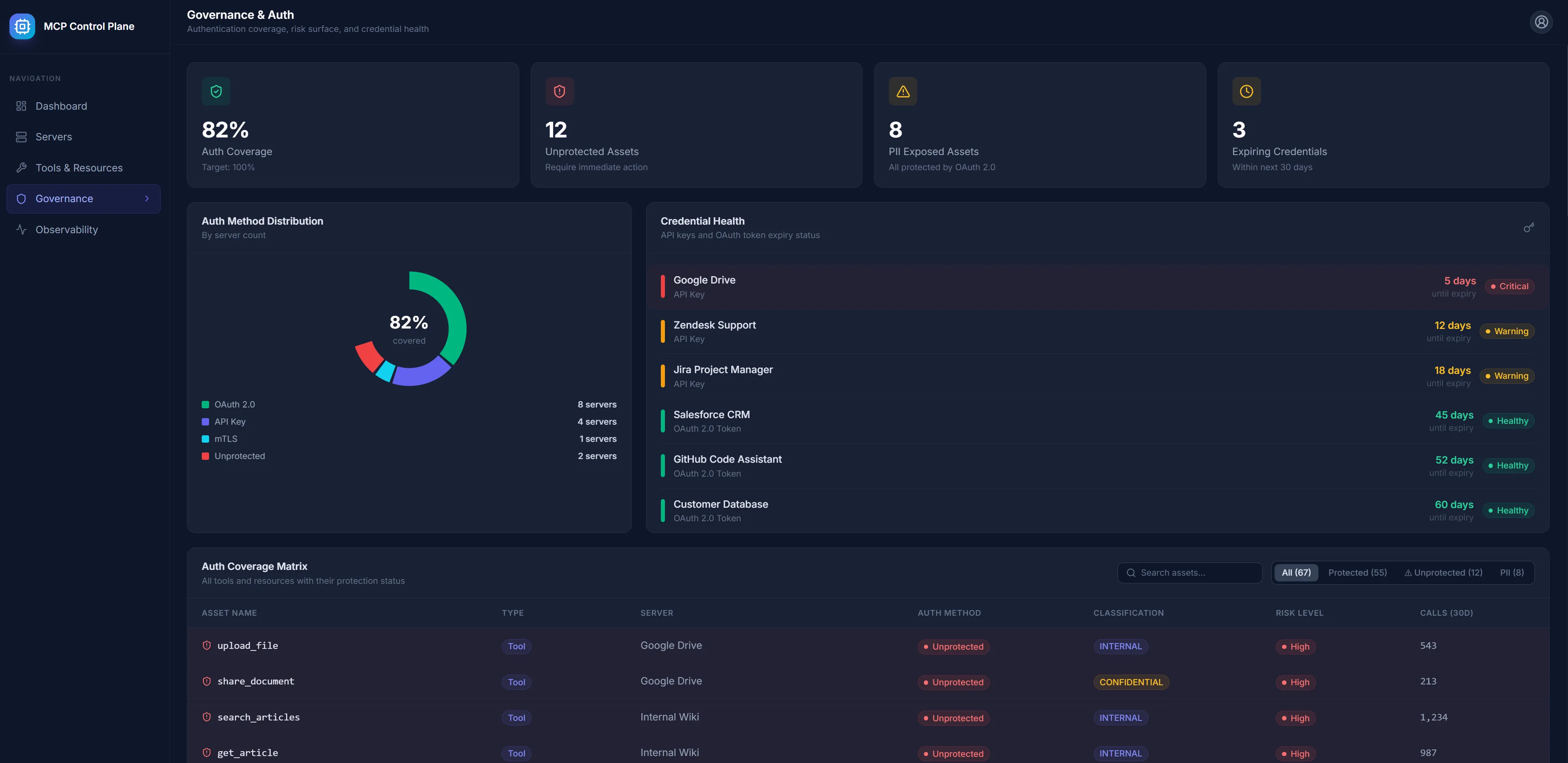
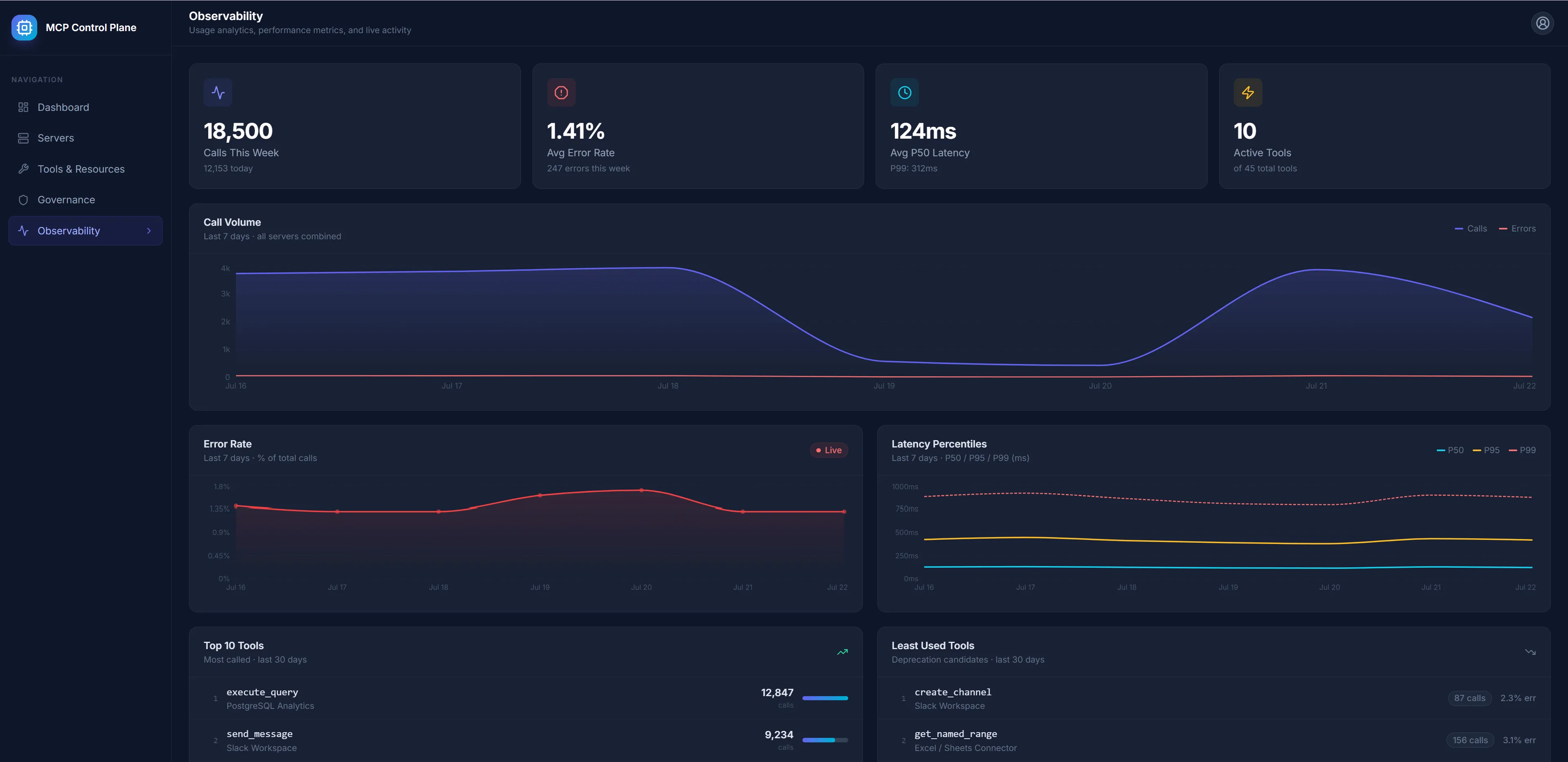
The four screens below come from our control-plane prototype, shown here as an illustrative concept with sample data sized to a typical client estate. They turn the five capabilities above from a list into screens a team would actually work in. The figures on them are sample numbers, not a live deployment.
Servers: the one place a team goes to see what is connected and whether every server is actually protected.
Tools & Resources: where you catch the ungoverned gaps - the exact actions and data an agent can reach, and which ones lack protection.
Governance & Auth: the screen a security review opens first, surfacing exposed data and expiring credentials before they become an incident.
Observability: how you answer "which agent did what, and is it healthy" after the fact instead of guessing.
Connecting AI to enterprise systems is not a new frontier for us - MCP standardises a pattern we already build. In our invoice-digitalization work, an AI processing agent extracts data from documents and pushes it straight into a client's ERP over a REST API. MCP describes exactly this kind of system-to-agent connection, in a reusable form any compliant agent can pick up.
The LLM model licence is the brain. MCP is the hands - the standard way to give an agent secure, scoped access to the systems it needs to be useful. A control plane is the nervous system that keeps all of it governed, observable, and accountable as you grow.
The practical first step is not a platform purchase. It is a decision: which of your systems should become agent-accessible first, and how access is governed from day one. If that is the conversation you are ready to have, talk to us.